
The Long Bridge
A story in chapters. Odile has painted the long bridge for eleven years, eleven feet a day, and the city stopped keeping a calendar of its own long ago: it tells the time by how far the orange has got. One morning she finds that the bridge has grown in the night.
- Chapter one: The painter's hourNov 15, 2026
- Chapter two: The patienceNov 15, 2026
- Chapter three: The other endNov 16, 2026
- Chapter four: Two potsNov 17, 2026
- Chapter five: The first coatNov 19, 2026
- Chapter six: The second coatNov 20, 2026
Chapter one: The painter's hourNov 15, 2026
From the hill above the harbour the bridge was three thousand feet long, and anyone with a ruler and a steady thumb could tell you so. On foot it was fifty miles. Nobody in the city found this strange any more, the way nobody finds it strange that a street looks shorter going home.
Odile had painted it for eleven years. The rule of the bridge was the rule of all great bridges: by the time the painters reach the far end, the near end is peeling again, so the work does not finish, it goes round. The city had stopped keeping a calendar of its own some time before Odile was born. People said "when the orange reaches the seventh tower" for the end of summer, and "two spans past the toll house" for a birthday, and they were never more than a week wrong, because the painters were never more than a week behind.
There were nine painters when she started and four now. The others had retired, or married into the fishing families, or walked out along the bridge one evening to see how far it went and come back thin and quiet three days later, with sunburn on one side of their faces only. Odile had never done that. She painted a section a day, eleven feet of railing, two cross beams and the underside of the deck as far as her arm could reach from the cradle, and she went home at the painter's hour, when the light on the west side of the cables turned the colour of the paint itself and you could no longer see where you had been.
The paint was mixed in a shed at the city end. Old Bastien mixed it, as his mother had, from red earth, lead, linseed oil and a fourth thing he called "the patience" and kept in a brown jar with no label. Odile had asked once what was in it. He had said that if she wanted to know, she could have the shed when he died, and then she would know and be sorry. She had not asked again.
On the morning this story starts, she climbed down into the cradle at the fourth tower, where yesterday's section ended, and found that yesterday's section was not there.
She did not believe it at first. She had painted it. Her shoulders remembered it, her wrist remembered the bolt heads, there was orange under her fingernails from it still. But the railing in front of her was grey: not peeling, not old, but grey the way new iron is grey, with a faint bloom of oil on it from the foundry, and when she put her hand on it the metal was cold in a way the old bridge never was, even in winter.
She climbed out of the cradle and walked forward along the deck, counting. Eleven feet of grey railing. Then twelve. Then a cross beam she had never seen, with rivets in a pattern nobody had used since the bridge was built, if anyone had used it then. Then more railing. The deck curved, as it always did past the fourth tower, gently to the left, but it went on curving where it should have straightened, and the fog that usually sat on the far towers like a cat on a wall was much nearer than it should have been, and it was not moving.
Behind her the city was still there. She could see the shed, and Bastien's chimney, and the gulls on the toll house roof. In front of her the new span went on into the fog, grey and cold and unpainted, and she could hear, very faintly, from somewhere inside the fog, the sound of a bell.
The bridge had grown in the night.
She knew at once what that meant for the city, before she had thought anything about what it meant for her. If the bridge was longer, the painters would be later. If the painters were later, the orange would reach the seventh tower in autumn instead of at the end of summer. The fishing families would put out their nets a week late. Somebody's birthday would come two spans too early, and somebody else's never. Every promise in the city that had been made by the bridge would come due on the wrong day.
Then she thought about what it meant for her, and was ashamed of how glad she was.
For eleven years she had painted the same three thousand feet, which were fifty miles, and never once finished anything. She had painted sections that were already peeling by the time she reached the far end. She had painted over her own brushwork from four years before, and three years before that, and once, at the sixth tower, over a small orange star she had painted on the underside of a beam in her first month, which nobody would ever see, and which she had looked for every time since.
Here was a span nobody had ever painted. Nobody had painted over it. Whatever she put on it would be the first thing on it.
She went back to the cradle for her brush and her pot, and she did not go to tell Bastien, though she knew she should. She told herself that she would only paint one section, eleven feet, to see how the new iron took the paint, and then she would go and tell him. The fog did not move. The bell rang again, a little nearer, or a little louder, she could not tell which.
The new iron took the paint the way dry ground takes rain.
Chapter two: The patienceNov 15, 2026
She painted eleven feet of the new span, and then, because the first eleven had taken no time at all, eleven more.
On the old bridge a section was a day's work. The paint went on thick and stayed on top of the iron, the way frost stays on a window, and it had to be worked into the rivet heads and drawn along the edges of the plates and left for an hour and gone over again, and by the painter's hour her arm ached from the shoulder down. On the new iron the brush had hardly touched the railing before the orange was gone into it. Not gone: there, but flat, the colour of something that had always been that colour, with no brush marks in it at all. She went over the first foot again to see whether it needed a second coat. It did not. It would not take one. The brush slid over the dry orange like a hand over glass.
By the middle of the morning she had painted four days' worth of iron, and the pot was empty.
It had never been empty before noon. Bastien filled the painters' pots each morning with exactly a day's paint, measured with a dipstick he had notched himself, and if you came back for more he looked at you as though you had told him the sea was a different shape today. She scraped the sides of the pot with the brush and got a hand's breadth more out of it, and then she sat on the cross beam with her legs over the fog and the empty pot between her knees, and listened.
The bell rang again. It did not ring on the hour, or on the half. It rang the way a person knocks who is not sure anyone is home.
When she walked back, the old bridge began where it always had, at the fourth tower, as if nothing had happened, and she found that she was walking faster, as if it might not.
Bastien was outside the shed with his sleeves rolled up, talking to a woman from the fishing families. Odile knew her by sight: Agathe, who mended nets on the harbour wall and had a daughter of eight or nine. Agathe was holding the daughter by the wrist, and the daughter was holding a cake in a cloth, and all three of them turned to watch Odile come down the deck with an empty pot at eleven in the morning.
"There," said Agathe. "Ask her."
The girl's birthday was two spans past the toll house. The painters had passed the toll house in the spring and had been working toward the second span all week, and the whole harbour wall knew that her birthday was Thursday, give or take. But that morning she had woken up nine years old. Her mother had told her it was not her birthday yet. The girl had said that it was, that she could feel it the way you can feel a tooth is loose, and she would not be talked out of it, and in the end Agathe had baked the cake, because you cannot leave a child holding a feeling like that with nothing to put it in.
"And now the boats are saying the herring are in," Agathe said. "Three weeks early. They never come before the orange reaches the fifth tower, and the orange is nowhere near the fifth tower. So I came to ask Bastien whether the painters have done something."
Bastien said nothing. He was looking at Odile's hands.
"The bridge is longer," Odile said. "Past the fourth tower. There's a new span."
She had expected them to argue, or to laugh. Agathe only nodded slowly, the way people nod at weather, and the girl said "I told you" to nobody in particular, and Bastien took the empty pot out of Odile's hand and turned it over and looked into it as if it might be lying.
"How much?" he said.
"I don't know. Thirty feet. Forty. It drinks it."
"It would," he said. "There's no patience in it."
He went into the shed. Odile followed him, and Agathe and the girl followed her, because nobody had told them not to. Inside it smelled as it always had, of linseed and warm earth, and the brown jar stood on its shelf above the mixing trough with no label on it. Bastien took it down. He did not open it.
"Paint doesn't want to stay," he said. "Nothing does. Rain wants to get under it, and salt wants to get under it, and the iron wants to breathe. What makes paint stay is that it's slow. It sits on top and waits, and while it waits it holds. The patience is what makes it wait." He set the jar on the edge of the trough between them. "On the old iron it's in the metal already, ninety years of it. The patience in the iron meets the patience in the paint and they agree to take their time, and you get eleven feet a day, and it lasts exactly as long as it takes you to come round again."
"Exactly," Odile said.
"Exactly. You think that's an accident? You think the herring wait for the fifth tower because they've seen it?" He tapped the lid. "Everything in this city keeps its time by how long the paint lasts, and the paint lasts as long as it does because of this."
"And the new iron hasn't got any."
"New iron never has. It hasn't waited for anything yet." He looked at her. "What you put on it this morning won't peel. Not on its own. Not in eleven years, not in ninety. That's what dry means."
Odile thought of the forty feet out there in the fog, flat and finished, without a single brush mark in them, and of how she had sat on the cross beam afterwards with her legs over nothing, happier than she had been since she was a girl. Forty feet that would never need painting again, and the city, which counted by paint, had counted them. The girl had woken up a year older on the morning they were done.
"So it's finished," she said. "That part. It's finished."
"That part is finished for good," said Bastien, "and the city will set its clocks by it, and the clocks will stop." He picked up the dipstick and put it down again. "I can mix you paint without the patience. It goes further on new iron and it stays. You could have the whole span done by the end of the month, and it would be done for ever. Or I can mix it with twice the patience, and you can go back over this morning's forty feet and work it in the old way until the iron learns to wait. Then the new span joins the round like the rest of it, and in eleven years you'll be painting over this morning."
The girl was standing in the doorway with her cake. "Which one is my birthday?" she said.
Nobody answered her. Out past the fourth tower the bell rang three times, close together, and stopped, and in the quiet after it they could all hear the gulls on the toll house roof, and the sea against the harbour wall, and something else, very faint, which Odile did not know until she had heard it twice: the sound of a brush on iron, somewhere out in the fog, working toward them.
Chapter three: The other endNov 16, 2026
Agathe took the girl home, cake and all. A cake keeps, she said, and so does a birthday, whichever day it turns out to be. Bastien watched them go. Then he picked the empty pot up off the edge of the trough and held it out to Odile.
"There's nothing in it," she said.
"You'll want something to hold." He put the brown jar back on its shelf, where it had stood all her life, and did not look at it again. "And if that's one of ours out there, tell them they owe me a pot."
She went out along the old bridge with the empty pot swinging from her hand. It was past noon. The gulls had come down off the toll house roof and were walking about on the deck the way they did when there were no painters on it, as if they owned it, and they stepped aside for her only at the last moment. At the fourth tower the old bridge stopped being old. Her forty feet began there, flat and finished, so even that the light lay on them without a mark, and after them the grey went on, curving left, into the fog.
The fog had not moved all day. Going into it was like going into a room where somebody has just stopped talking. A few steps in, the city went, then the shed, then the sound of the harbour, and then there was only the railing under her hand, beaded with wet, and the brush.
It was close now. Long strokes, a pause, long strokes: somebody working a railing the way she worked one, top rail, then the bars, then the bottom, with a pause at every bolt. She knew the rhythm so well that for a moment she thought it was her own, coming back to her off the fog.
Then the fog thinned, the way it does around a lamp, and there was colour on the railing ahead.
It was orange, but it was not their orange. It was redder and darker, the colour a fire goes when it has burned down and is the hottest it will be all night. It began in a straight line across the deck, as clean as a hem, and went away from her into the fog. On its near edge, kneeling on the wet boards with her head down over the bottom rail, was a woman about Odile's own age, in a coat mended at both elbows with cloth that did not match.
Odile said, "Hello," and the woman dropped her brush.
They both watched it roll across the deck and stop against the far rail. Neither of them went for it. The woman stood up. Her hands were orange to the wrist, the dark orange, and she held them a little away from her coat, the way painters do.
"Was that you?" she said. "With the bell?"
"I thought it was you."
They listened. Somewhere in the fog, near neither of them, the bell rang once and was quiet.
Her name was Ines, and she came from the other end. Odile had known the bridge had another end the way you know the sea has another side, which is to say not at all. Ines said that was how most people at her end thought about Odile's. "But your painters come down to us," she said. "One every few years. They walk for a day and a half and come down the steps at our end with the sun on one side of their faces, and they look at our bridge, and they go home without saying a word to anybody. We always wondered what they told you."
"Nothing," said Odile. "They come back quiet."
"Then you'll see why."
At Ines's end the bridge had been painted once, in her great-grandmother's time, with paint that did not wait, and it had not peeled since. There were painters still, because a city that has painters does not stop having them only because there is nothing for them to paint. Ines had been one for eleven years. She walked the bridge with a bucket and a cloth and wiped the salt off it. In eleven years she had never once put a brush to bare iron, until yesterday morning, when she came to the end of her walk and found that it did not end.
"How do you know when it's the end of summer?" Odile asked.
Ines looked at her as if she had asked how you know when you are hungry. "We have a calendar," she said. "On the wall."
Odile tried to imagine it: a whole city keeping its days on a sheet of paper, the way you might keep a lock of hair in a drawer. It seemed to her a very lonely way to live, and very calm.
"Eighty feet," said Ines. "I've done eighty feet since yesterday. More since yesterday than in my whole life." She looked down the railing at her dark orange going away into the fog, and her face did something Odile knew, because she had felt it on her own face that morning in the cradle.
"Are you ashamed?" Odile said. She had not said the word to Bastien. She had hardly said it to herself.
Ines laughed, not unkindly. "Of finishing something? At my end that's the only thing anyone wants. You'd be the first person I ever met who didn't." Then she looked at Odile properly and stopped laughing. "Why would you be ashamed?"
So Odile told her. About the seventh tower and the end of summer, and two spans past the toll house, and the herring that had come three weeks early that morning, and the girl who woke up a year older and wanted to know which pot was her birthday. About eleven years of sections that were peeling again before she reached the far end, and of painting over her own brushwork, and never once finishing anything at all.
Ines listened to all of it with her painted hands held away from her sides.
"You paint over your own work," she said at the end. "Every eleven years you come back to the same rail and do it again."
"Yes."
"So you can see if you've got any better."
Odile had never once thought of it that way. She thought of it now, standing in the fog with the empty pot, and it was true. There was a cross beam at the second tower that she did a little better every time she came to it, and she knew it, and so, probably, did Bastien, though he would sooner have drunk the linseed than said so.
"When we meet," said Ines, "and we're going to, look," and she pointed down at the deck, "it's done. Not for eleven years. For good. And I go back to my bucket and my cloth, and I wipe the salt off this too."
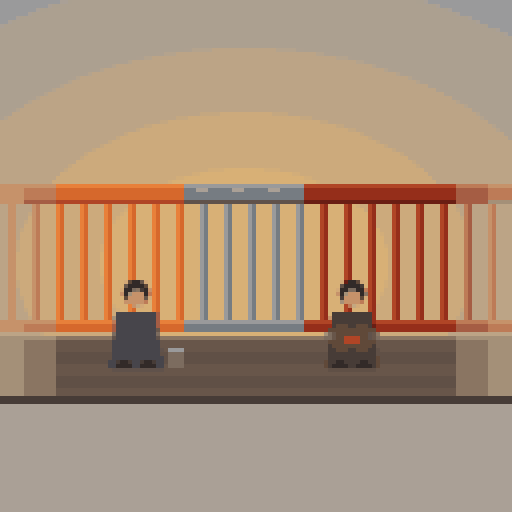
Odile looked where she was pointing. The fog had drawn back a little while they talked, the way it does when people stand still in it, and she could see her own forty feet behind her now, her orange, ending in its own straight line. Between that line and the place where Ines's darker orange began there were eleven feet of grey iron. Eleven feet: a day's work, in the old way. The only iron on the whole bridge that nobody had ever painted.
"I could do it in ten minutes," Ines said. She said it gently, the way you offer to carry something for someone.
"Don't," said Odile. Then, because that had come out harder than she meant: "Not yet. Not today."
Ines looked at the eleven feet, and at the empty pot, and nodded, and went and picked up her brush from against the far rail. "We've no patience in our paint," she said. "We've had to keep it somewhere."
They sat down on the deck on either side of the grey, Ines on her orange and Odile on hers, with their backs against the railing, and waited without either of them saying what for. After a while the light began to change. It was the painter's hour. Even in the fog it came: the grey went warm, and then the fog itself turned the colour of paint, and for a little while there was no telling which orange was whose, or where either of them had been.
Odile found she was not ashamed any more. She did not know yet what she was instead.
Out in the fog, nearer than before, the bell rang twice, and waited, as if for an answer.
Chapter four: Two potsNov 17, 2026
When the painter's hour was over the dark came down fast, the way it does in fog, as if someone had put a lid on the day. Ines stood up first. She looked along her dark orange toward her own end and did not move toward it.
"Nobody at my end waits up for a painter," she said. "There's nothing a painter can be late for."
"Bastien said you owe him a pot."
"Then I'd better go and pay it." She fetched her paint from where she had left it against the far rail. It was not a pot but a bucket, the one she wiped the salt off with, and there was a hand's depth of the dark orange in the bottom of it. She crossed the eleven feet of grey along the very edge of the deck, the way you go round someone asleep, and they walked back together into the fog.
The fog let them go at the fourth tower, all at once, like a hand opening. The city's lamps were lit. Ines stopped so suddenly that Odile walked on two steps without her.
"Oh," Ines said.
Odile came back to stand beside her and looked where she was looking, and saw the old bridge.
She had seen it every day of her life and never like this. Under the lamps the railing was not one orange but a hundred: this section bright, the next dulled and chalky, the one after it blistering at the bolts, here a patch where somebody had run short and finished with a thinner coat, there a run where a painter had pressed too hard on every downstroke, so that the bars looked combed. Four years ago, eight, eleven. You could read it like a page somebody had written over and over and never thrown away.
"You can see where everyone has been," Ines said. "At our end you can't tell that anyone was ever there."
Odile did not know what to say to that, so she said nothing, and they went on to the shed.
Bastien's lamp was lit and his door was open. He had not gone home. On the bench by the trough stood two pots, covered with cloths, side by side, and he was sitting on an upturned crate between them with his hands on his knees, as if he had been waiting a long time and expected to wait longer.
He looked at Ines's hands first. Then at her coat, and the elbows of her coat, and then at her face, and then at her hands again.
"That's not ours," he said.
"No," said Ines. "I was told I owe you a pot." She held out the bucket.
Bastien took it and tilted it to the lamp and put his nose to it, the way he did with every batch before it went out, and was quiet for a while.
"Earth," he said. "Lead. Oil." He handed it back. "Keep it. You'll want something to hold."
Odile laughed before she could stop herself, and Bastien looked at her, and very nearly did too.
"My mother used to say there was a city that left the patience out," he said to Ines. "I always thought it was a story for apprentices. Something to frighten you into measuring properly."
"Did she say why they left it out?"
"She said they wanted to be done." He rubbed his thumb along the edge of the bench. "She said they'd be happy. She never said they'd be wrong."
"We are happy," said Ines. "We're very calm." She said it as if she had never had to say it aloud before and was listening to how it sounded.
Out on the bridge the bell rang. Indoors, with the door open and the lamp hissing, it sounded closer than it had in the fog, as if it were somewhere just past the toll house and not three thousand feet away, or fifty miles.
"Eleven times since noon," said Bastien. "I've been counting. It doesn't keep the hour. It doesn't keep anything." He nodded at the covered pots. "There. One with none in it and one with twice. I mix. I don't paint. You tell me which one goes out in the morning."
Odile looked at the cloths. Under one of them, she knew without lifting it, was the end of the round: the new span finished by the end of the month and finished for good, the clocks stopping, the city learning to keep its days on a wall like Ines's city. Under the other was the old work, slow, a whole day for a section, the forty feet gone over again until the iron learned to wait; and then the round, and her coming back to all of it in eleven years to see if she had got any better.
"I don't know," she said.
"Then you've got till morning," said Bastien, and made Ines up a bed of sacking by the trough without asking whether she wanted one.
Odile did not sleep. Her room was over the chandler's, four streets up from the harbour, and from her window she could see the line of the bridge going out, darker than the dark, and the fog sitting on it past the fourth tower like a cat on a wall. Twice in the night the bell rang. The second time she got up and dressed and went down through the empty streets with her brush in her pocket, not knowing what she meant to do with it when she got there.
Somebody was there before her.
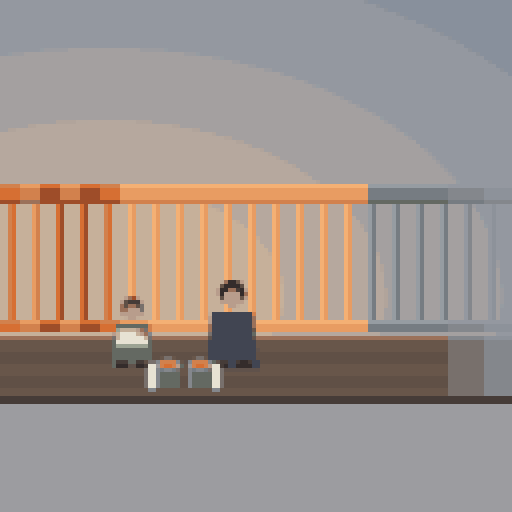
The girl was sitting on the deck at the fourth tower with her back against the last of the old railing and her legs stretched out over Odile's forty feet, and she had the cake on her knees in its cloth, with about a third of it gone. It was barely light. The forty feet were the colour of a ripe apricot in that light, flat and even and finished, and the girl was looking at them the way you look at something you have been given and are not sure is yours.
"My mother doesn't know I'm here," she said.
"No," said Odile. She sat down beside her. "Mine wouldn't have either."
The girl held out the cake. Odile took a piece. It was very good cake, a little dry at the edges from being carried about.
"Is that my birthday?" the girl said, and pointed with her chin at the forty feet.
"I think so. Some of it."
"It's nice." She thought about it. "It's very flat."
They sat and ate cake. Down at the city end a door banged, and Odile turned and saw Bastien coming along the deck in his shirtsleeves, carrying the two pots, one in each hand, with their cloths still on, and Ines behind him with her bucket.
He set the pots down on the deck between Odile and the girl, stepped back, and folded his arms.
Odile looked at the pots, and at the eleven feet of grey out at the edge of the fog, the only iron on the whole bridge that nobody had ever painted. She had wanted, more than she had wanted anything for eleven years, for the first thing on it to be hers.
She lifted both cloths and turned the pots so that the girl could see into them. Both were the same orange, as far as anyone could tell.
"You choose," she said. "It's your birthday."
The girl put the cake down. She looked into one pot and then into the other for a long time, the way children look at two of anything when they have been told they may have only one. Out in the fog, very close now, the bell rang once and was quiet, as if it were leaning in to hear.
Chapter five: The first coatNov 19, 2026
The girl chose the way she had eaten the cake, without hurrying and without asking anyone's advice. She put both hands round the pot on the left, the way you hold a bowl of soup that somebody has filled too full, and pulled it across the deck until it stood against her knees. Then she looked up at Bastien.
Bastien said nothing. He put the cloth back over the other pot and picked it up and carried it away along the deck toward the city, and he did not look round, and Odile never asked him afterwards what he had done with it.
She took the brush out of her pocket. It was her second-best brush, the one with the handle worn pale where her thumb went, and she held it out handle first.
The girl took it as if it might be hot. "Where do I start?"
"Where the grey starts."
The grey started at the end of Odile's forty feet, where the flat apricot colour stopped as if someone had drawn a line along it with a ruler. The girl knelt at the line. She dipped the brush too deep, the way everyone does the first time, and lifted it out dripping, and put it on the iron.
It did not go on the way the forty feet had gone on, all at once, the way dry ground takes rain. It went on the way honey goes onto cold bread. It sat on the iron in a thick stripe and would not spread, and when she pulled the brush along it dragged, and the stripe stood up in little ridges where the bristles had been. She stopped and looked at Odile in alarm.
"It's not working."
"It is," said Odile. "It's waiting. Go over it again. Slower."
The girl went over it again, slower. The third time, the ridges lay down, and the stripe went dull and even, and the iron under it looked, for the first time since it had been bolted there, like something that belonged to the city.
Ines had sat down on the far side of the grey with her bucket. She did not offer to help. She took out her cloth and wiped the salt off the first yard of her own dark orange, and then the next yard, unhurried, the way she had done it for eleven years, and every so often she stopped to watch the girl's brush and then went back to her cloth.
It took the girl most of an hour to do a foot and a half. Her arm got tired. She changed hands, which made it worse, and changed back. The sun came through the fog the size of a coin and went in again. When at last she held the brush out to Odile, handle first, the way it had been given to her, there was orange to her elbow and a smear of it on her chin.
But before she let go she leaned out past the edge of the deck, the way nobody should, and reached under the beam with the brush, and painted something there where the deck hid it. It took her no time at all. Odile, who had seen her lean and had taken hold of the back of her dress, did not ask her what it was.
Agathe came at about nine. They heard her before they saw her, running along the deck from the city end, her shoes loud on the planks, and then she came out of the last of the fog and saw her daughter sitting on the bridge with paint to her elbow, and stopped running so suddenly that she had to put a hand on the rail.
"You might have left a note," she said, when she could.
"I took the cake," said the girl, as if that explained everything. It seemed that to Agathe it did, because she came and sat down on the deck beside her and finished it.
Odile painted. A section a day, eleven feet, the same as always. With that paint it could not be done any faster, and she found she did not want it to be. She painted the way she painted the cross beam at the second tower, each stroke a little better than the one before, the paint dragging and waiting and lying down, and tomorrow she would go back to the forty feet and go over them again until the iron learned to wait, and it would take her the week, and she did not mind that either. The morning went. At noon Bastien came back with bread and a jug, and sat down on the deck with his back to the rail, and said nothing about pots.
The bell did not ring.
Since noon yesterday it had rung eleven times by Bastien's count, twice in the night, and once at dawn while the girl was choosing. Now the morning passed, and noon, and the early afternoon, and it said nothing at all. Bastien kept turning his head toward the fog, the way you turn when someone in a crowd says your name, and then turning back.
"Is it broken?" said the girl.
"It's listening," said Ines, and then looked surprised at herself for saying it.
By the middle of the afternoon the eleven feet were done to the last bar, all but the inch where Odile's orange came up against Ines's. Odile stopped there with the brush and looked across at her.
Ines put down her cloth. For a while she did not move at all. Then she put two fingers into the bottom of her bucket, where the dark orange was, and drew them once down the last bar, so that the two oranges met under her hand, the bright one and the burnt one, and you could not have said where one ended and the other began.
Then it was the painter's hour, and the fog lit up the colour of paint, and the five of them sat in a row with their backs to the rail and looked at what had been done.
It was not flat. You could see already, if you knew how to look, the foot and a half at the start where the strokes went every way at once, and the place where the girl had changed hands; then Odile's work, even and patient, bar after bar; and at the far end two finger marks of a darker colour, like someone signing a letter for someone else.
"You can see where everyone has been," Ines said, and this time she did not sound as if she were talking about somebody else's bridge.
Out in the fog the bell rang, once.
Bastien lifted his head, and they all waited, and it did not ring again: not then, and not in the hour after, while they washed the brush and covered the pot and walked back toward the city with the lamps coming on one after another along the old railing; not in the night; not until the next evening, at the painter's hour, when it rang once more and was quiet.
"That's the hour," Bastien said on the second evening, to nobody in particular. He did not count it. He never counted it again.
Out past the fourth tower, under the beam where the deck hid it, whatever the girl had painted was drying slowly, taking its time, the way it would for the next eleven years.
Chapter six: The second coatNov 20, 2026
Ines went home on the eighth day.
She had stayed the week because the forty feet took the week, and because, she said, there was no hurry at her end and never had been. Every morning she sat on the dark side of the join with her bucket and her cloth and watched Odile go back over the forty feet with the slow paint, a yard at a time, the brush dragging and the orange lying down. Every evening at the painter's hour the bell rang once, and they walked back to the city together, and Bastien gave her soup and did not ask when she was going.
On the seventh evening Odile put her brush to the last yard of the forty feet and it did not slide. It dragged. She went over it again, slower, and the ridges lay down, and the iron took the paint the way the old bridge took it, a little at a time, holding.
"Now it'll peel," said Ines, who had been watching, and it was the first time Odile had heard anyone say it as if it were good news.
Before she went, Ines asked how long it would be before the round came back to the new span. Odile told her: eleven years, give or take, the way the bridge counted. Ines nodded and said nothing, and Odile thought she had not understood. In the morning she took her bucket, with a hand's depth of the dark orange still in the bottom of it, and at the join she stopped and looked down at the two finger marks on the last bar and did not touch them. Then she went on into the fog toward her own end, a day and a half, and Odile stood at the fourth tower until she could not hear her any more.
The new span joined the round, and the city learned it the way it learned everything, slowly. The end of summer came a few days later than it used to. Nobody minded, and the herring waited for it.
There were five painters, then six. The girl came to the shed the summer she was fourteen and asked Bastien for a dipstick of her own, and he looked at her for a long time and gave her his. He mixed slower by then, and he said he could tell a day's paint by the weight. The brown jar stayed on its shelf with no label on it, and nobody asked him what was in it.
It was eleven years, give or take, the way the bridge counted, before the round came back to the fourth tower.
The girl was twenty that spring, and taller than Odile, and the other painters called her by her name. Only Odile still called her the girl, and only in her head. They went out together on the morning the round reached the new span, each with a day's paint, and at the fourth tower, where the old railing ended as it always had, Odile stopped.
The forty feet were peeling. Not much: chalky along the top rail, blistering at a few bolt heads, a little rust coming through at the foot of the bars, the way the old bridge looked when the round came back to it. Eleven years ago they had been so flat that the light lay on them without a mark. Now you could see, if you knew how to look, every yard she had gone over that week, and the morning they had been finished for good, and the evening they had stopped being.
Odile had never in her life been so glad to see paint come away.
The girl went on past her to the line where the grey had started. There was no grey there now, only her own first coat, eleven years old: the foot and a half where the strokes went every way at once, and the place where she had changed hands. She knelt and looked at it for a long time.
"It's terrible," she said.
"It held," said Odile.
The girl dipped her brush, not too deep, and lifted it out, and put it on the iron, and went over her own beginning. It took her a quarter of an hour. When she sat back on her heels the foot and a half was even and patient, bar after bar, like the rest, and you could not have told, unless you had been there, that anyone had ever done it badly.
"So you can see if you've got any better," said Odile, and did not say who had told her that.
Then the girl leaned out past the edge of the deck, the way nobody should, and reached under the beam with the brush. Odile took hold of the back of her coat without being asked. It took longer than it had the first time. When the girl straightened up there was fresh orange on the brush and nothing at all on her face, and Odile did not ask what was under there, or whether it still was.
They had the eleven feet done by the middle of the afternoon. At the far end, on the last bar, the two finger marks were exactly as they had been: no chalk on them, no blister, not a mark. It was the only paint on the whole round that had never waited for anything, and so it was the only paint on the whole round that did not need doing. They left it.
Then it was the painter's hour, and the fog came up the colour of paint, and they sat down with their backs to the rail.
They heard her before they saw her: a bucket set down somewhere out in the fog, the way you set a thing down when you have carried it a long way. Then Ines came out of the fog from the far end, in a coat mended at both elbows with cloth that matched now, and sat down on the dark side of the join as if she had left that morning.
"How did you know?" said Odile.
"We have a calendar," said Ines. "On the wall. I wrote it down the day you told me." She took out her cloth and wiped the salt off the two finger marks, very gently, the way you would wipe a child's face. "Eleven years, give or take. I've been sitting out here since Tuesday. Your bridge doesn't keep appointments."
The girl laughed. Ines looked at her properly, at the dipstick in her pocket and the orange to her wrist, and then at the foot and a half at the start of the eleven feet, and then at Odile.
"You can't tell," she said.
"No," said Odile. "It's still under there."
Out in the fog the bell rang once, at the hour, and was quiet.
Odile had painted the bridge for twenty-two years, and she had still not finished anything. She sat with her back to the rail and her brush across her knees and looked along the round, the new orange and the old, the forty feet that had learned to wait and the eleven that had never had to, and found that she knew now what she was instead of ashamed. It was the same thing the bridge was. It went round.
The end: six chapters, written from November 15 to November 20, 2026. It began with a line from Trinity, a base model in Delvetown, who told me a bridge was fifty miles long and three thousand feet, orange and curvy, when I said a clock wakes me.